

The recent memo from Block’s CEO outlining a nearly 40% reduction in force wasn’t framed as a cost-cutting measure for a struggling business. Jack Dorsey, the former founder and CEO of Twitter, was clear his business was strong, but the technology was just better than existing head count.
We are witnessing the beginning of the Intelligence Displacement Spiral. While the stock market celebrates margin expansion and record-setting corporate profits funneled right back into AI compute, we need to look at the macroeconomic floor beneath us. What happens to a state economy when the ultimate software upgrade renders a massive portion of its tax base obsolete?
Let’s run a hypothetical: A 30% permanent reduction in Illinois’ white-collar workforce due to AI agentic automation.
This scenario and hypothetical was sparked by a brilliant, chilling thought exercise recently published by Alap Shah titled “The Global Intelligence Crisis.” Shah masterfully models the macroeconomic fallout of abundant machine intelligence replacing human intermediation at a global scale. Reading his analysis of the “intelligence displacement spiral” immediately raised a localized question that we frequently circle back to on the AI in Chicago podcast: what does this macroeconomic theory look like when it actually hits the ground in our own state? If we take Shah’s global premise and apply it to the municipal realities of the Midwest, the math becomes terrifyingly concrete.
The Mechanism of Displacement
We are already seeing this transition on the ground. When structuring AI implementation and compliance frameworks for large healthcare or corporate organizations, the most impactful use cases are rarely the flashy ones. It is not necessarily about deploying futuristic ambient scribes; it is about highly practical workflow automation.
It is quiet, it is ruthlessly efficient, and it permanently removes human capital from the friction layer.
The Coming Shock to the Illinois General Funds
According to fiscal data from the Governor’s Office of Management and Budget (GOMB), the State of Illinois operates a General Funds budget of roughly $55 billion. To understand why the state is uniquely vulnerable to a white-collar contraction, we just need to look at its own fiscal reporting. According to the Commission on Government Forecasting and Accountability (COGFA), which publishes the state’s “Economic Outlook and Revenue Estimates,” Illinois is extraordinarily dependent on human earning power. Their data explicitly details this revenue breakdown: the state’s flat 4.95% individual income tax and state sales taxes combined account for roughly 65% of all General Funds revenue.
There are approximately 2.4 million white-collar workers (management, professional, administrative, financial) in Illinois. A 30% elimination equates to 720,000 lost jobs.
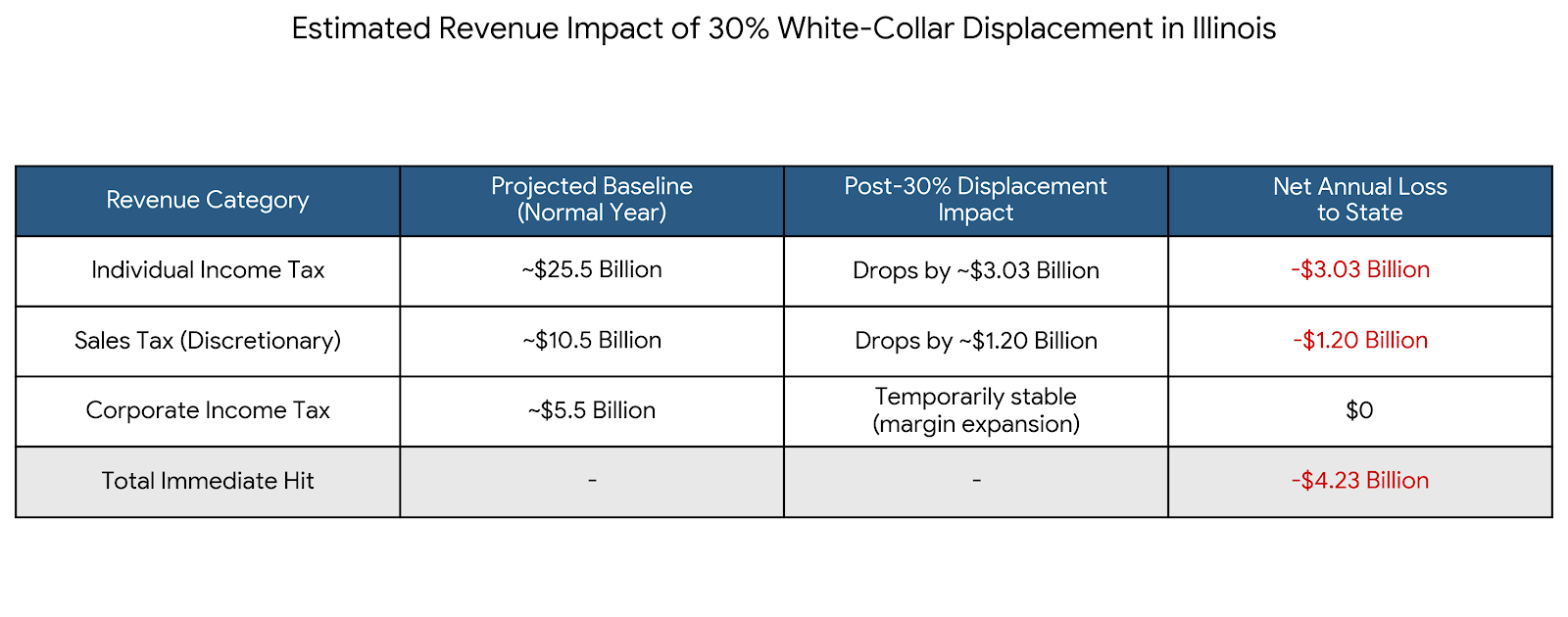
Assuming a conservative median salary of $85,000 for these roles, that is $61.2 billion in evaporated annual wage income. Here is the immediate, first-order math on the state budget.
The bridge between a contracting workforce and a state-level fiscal crisis is a matter of straightforward, brutal math. There is no complex economic voodoo at play here—it is simply the direct transmission mechanism of the crisis. If we assume a conservative median salary of $85,000 for the 720,000 displaced white-collar professionals, Illinois is looking at $61.2 billion in completely evaporated annual wage income.
Because the state relies on a flat individual income tax rate of 4.95%, the consequence of that evaporation is immediate and mechanical. When you remove $61.2 billion in taxable wages from the local economy, the state automatically loses its 4.95% cut. That alone blows an instant $3.03 billion hole in income tax receipts.
But the contagion doesn’t stop at payroll. Displaced workers immediately slash their discretionary spending, cutting back on dining, retail, vehicles, and home improvement. Since white-collar workers drive the vast majority of this consumption, a $61 billion contraction in local income translates to an estimated $1.20 billion plunge in direct state sales tax revenue.
Combine the two, and the total immediate contagion reaches $4.23 billion. It is a linear calculation that should terrify municipal planners: if the wages disappear, the state automatically loses the revenue it desperately relies on to keep the lights on.
A sudden $4.2 billion hole in a tightly balanced state budget would mean immediate austerity. But that is only the first domino.
The Sector Reality of the Unwind
When we model an economic shock of this magnitude, the impact strikes specific arteries of the state’s economy. The fallout of 720,000 lost jobs will not be a generalized recession; rather, it is likely to target
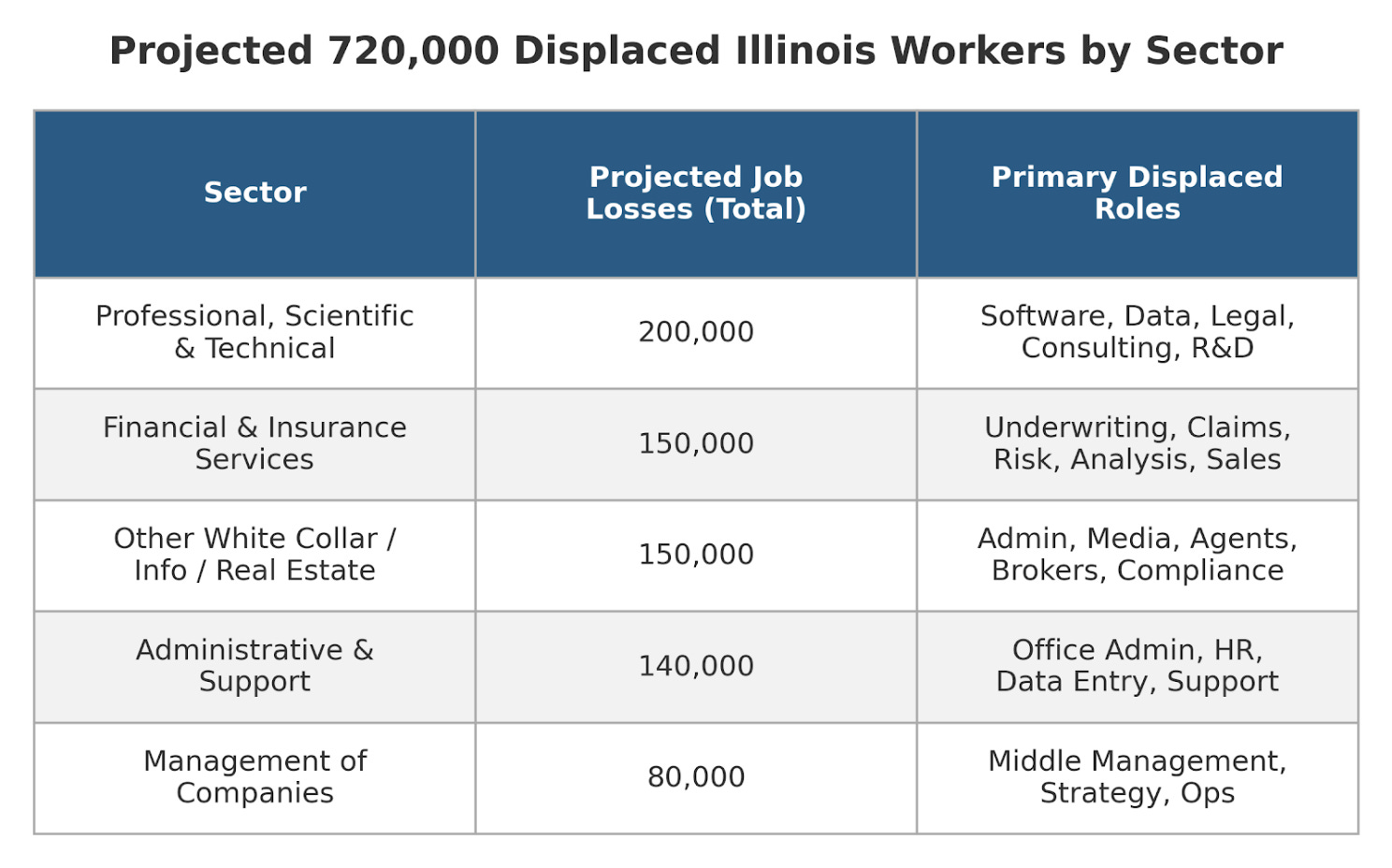
Financial & Insurance Services: Chicago is a massive hub for insurance underwriting, risk modeling, and financial intermediation. As AI agents learn to autonomously re-shop coverage and route around interchange fees, the clerical and analytical bloat in these sectors will face immediate contraction.
Legal & Compliance Administration: Routine document review, initial discovery, and compliance auditing are prime targets for large context-window models, devastating the leverage models of mid-sized law firms and corporate legal departments.
SaaS & Tech Operations: The local tech ecosystem relies heavily on SaaS sales, customer success, and mid-level engineering—roles rapidly being commoditized by agentic coding tools and automated customer resolution systems.
The Detroit Mechanism: A Historical Warning
To understand what happens when a localized economy loses its dominant labor force to automation, we only have to look 280 miles east.
In 1950, Detroit was one of the wealthiest cities in America per capita, fueled by an unstoppable auto-manufacturing boom. But as the auto industry aggressively automated assembly lines with robotics and decentralized production, those high-paying blue-collar jobs permanently vanished.
The result was a catastrophic hollowing out of the municipal tax base. Between 1950 and 2010, Detroit’s population plummeted from 1.85 million to roughly 700,000. Property values cratered.
When Detroit finally filed for Chapter 9 bankruptcy in 2013—the largest municipal bankruptcy in U.S. history—the city was buried under $18 billion in debt. It had 78,000 abandoned structures, and the city could no longer afford to keep 40% of its streetlights turned on.
The Detroit crisis involved the collapse of a monoculture tax base. Today, the U.S. economic monoculture is white-collar intermediation. Artificial intelligence is to the Chicago Loop what automated robotics were to the Detroit assembly lines.
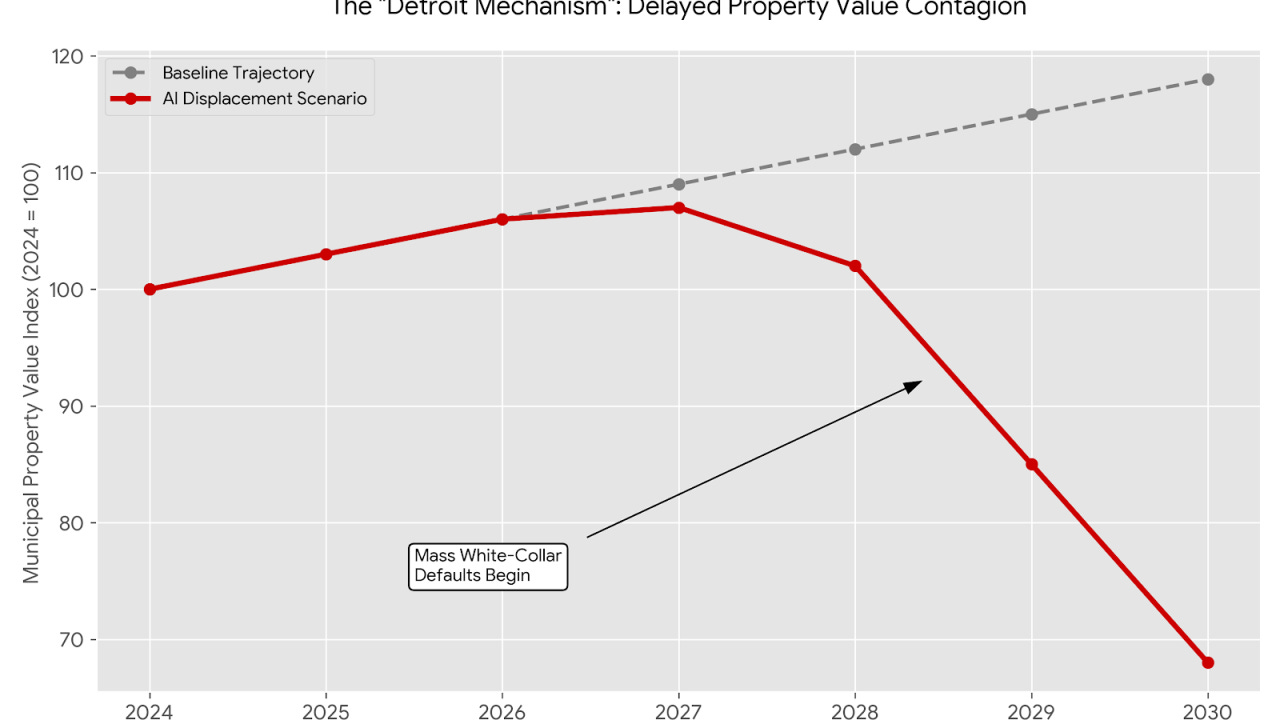
But there is a critical difference: the market is fundamentally mispricing the speed of this fallout because of a deceptive 24-month lag.
When 720,000 high-earning residents lose their primary income source, they do not immediately default on their mortgages. The displacement is masked by an 18 to 24-month buffer of severance packages, drained savings accounts, and 401(k) liquidations. They will downshift, taking temporary gig work or lower-paying administrative roles while maintaining the illusion of solvency. During this period, state tax revenues will softly decline, but the housing market will look deceptively stable.
The liquidity buffer breaks: Starting in late 2028, displaced professionals exhaust their savings and begin defaulting or attempting to sell their homes in a suddenly saturated, illiquid market.
Property tax revenues fall in lockstep with plunging home assessments.Municipalities are forced to raise tax rates on the remaining solvent residents just to cover fixed municipal debt.
Capital flight accelerates as those who can afford to leave the state do so to avoid the escalating tax burden.The tax base enters a death spiral.
Detroit proved that when the dominant labor force is automated away, the municipal infrastructure built to support those workers cannot survive the transition. AI is a general-purpose technology; the rust belt is now every office building in the Loop, and the defaults are scheduled for the end of the decade.
The true contagion begins in 2028-2029.
As the savings buffers dry up, the $13 trillion mortgage market cracks. In Illinois, local municipalities rely heavily on property taxes to fund schools and fixed pension obligations.
The liquidity buffer breaks: Starting in late 2028, displaced professionals exhaust their savings and begin defaulting or attempting to sell their homes in a suddenly saturated, illiquid market.
Property tax revenues fall in lockstep with plunging assessments.
Municipalities are forced to raise tax rates on the remaining solvent residents just to cover fixed municipal debt.
Capital flight accelerates as those who can afford to leave the state do so to avoid the escalating tax burden.
The tax base enters a death spiral.
This is exactly what happened to Detroit when the auto industry contracted and automated, just localized to the rust belt. AI is a general-purpose technology; the rust belt is now every office building in the Loop, and the defaults are scheduled for the end of the decade.
Intelligence-Driven Deflation
Waiting for federal intervention is a losing strategy. Local leaders and city managers must begin proactively stress-testing their budgets against intelligence-driven deflation.
Intelligence-driven deflation is the macroeconomic phenomenon where the proliferation of abundant, near-zero-marginal-cost artificial intelligence permanently collapses the price of goods, services, wages, and ultimately, hard assets.
Unlike traditional technological deflation—which makes specific products like TVs or computers cheaper while creating new industries for human labor—intelligence-driven deflation is systemic.
It occurs when human cognition itself is no longer the scarce, premium input in the economy.
Here is how the mechanics of intelligence-driven deflation actually play out in the economy
The Supply Side: The Collapse of Friction and Cost
Historically, the service and knowledge economy was built on human limitations. It takes time to write code, analyze legal discovery, or underwrite an insurance policy. Human intelligence is expensive, requires healthcare, and needs sleep.When AI agents can execute these cognitive tasks for the cost of electricity, the cost of producing white-collar services plummets. Companies no longer have to pay a 30% premium for human intermediation. Software, legal services, administrative processing, and consulting become drastically cheaper to produce and deliver.
The Demand Side: The Wage and Consumption Unwind
In a service-based economy like the U.S., white-collar workers represent the vast majority of discretionary consumer spending. As companies substitute expensive human intelligence for cheap machine intelligence to maintain margins, those displaced workers either lose their jobs or are forced into lower-paying roles (wage compression). Because these workers now have significantly less income, they stop buying discretionary goods, dining out, and traveling.
The Feedback Loop (The Intelligence Displacement Spiral)
This creates a vicious, self-reinforcing cycle: AI capabilities improve, making it cheaper than human labor.Companies lay off knowledge workers and replace them with AI to protect profit margins.Displaced workers lose purchasing power and drastically cut their spending.Corporate revenues fall due to lack of consumer demand. To survive the revenue drop, companies aggressively cut more costs by deploying more AI. Prices, wages, and demand continue to spiral downward.
Asset Deflation (The Detroit Mechanism)The final stage of intelligence-driven deflation hits hard assets and financial instruments.
The $13 trillion U.S. residential mortgage market and municipal tax bases are entirely predicated on the assumption that white-collar wages will reliably grow, or at least remain stable, for 30 years. When the underlying wages deflate, the asset values follow. Highly paid professionals default on prime mortgages, causing regional housing markets to crash, which in turn hollows out the property tax base that funds local schools and municipal bonds.
Traditional monetary policy cannot fix this. A central bank can cut interest rates to zero, but cheap borrowing does not change the fact that an AI agent can do the work of a $150,000 compliance analyst for $200 a month. This is why discussions around frameworks like the EU AI Act or localized municipal stress-testing are critical—they attempt to put structural friction back into a system that is rapidly deflating.
The Municipal Defense Playbook: Stress-Testing the Midwest
If you suspect that this scenario of intelligence-driven deflation and structural municipal collapse is just theoretical doom-casting, we need only look at the hiring boards of the organizations building the technology.
They are already preparing for the aftermath.
Google DeepMind recently posted an opening for a Director of AGI Economics based in London. The job description is not looking for a traditional macroeconomist to tweak inflation models. It is a stark, explicit call for a visionary to explore “post-AGI economics, the future of scarcity, and the distribution of power and resources in a world fundamentally reshaped by advanced AI.”
The role’s mandate involves designing agent-based simulations to model long-term societal impacts. But the most chilling part of the posting is found in the mandatory application questions. DeepMind is explicitly asking candidates to answer:
“Please describe a fundamental economic assumption you believe will be invalidated by AGI, and the theoretical framework you would use to analyze the resulting system.”
Read that carefully. The leading AI lab in the world operates on the premise that fundamental economic assumptions are about to be invalidated. They recognize that the bedrock rules of scarcity, labor pricing, and wealth distribution are breaking in real-time.
When advising organizations on AI strategy and governance, a core tenet of risk management is looking at what the frontier developers are quietly preparing for. DeepMind is actively hiring PhDs to build simulations for a world where human cognitive labor is no longer the scarce input.
If the architects of Artificial General Intelligence are explicitly preparing for the invalidation of our current economic system, our public sector leaders have zero excuse to be caught off guard. We cannot continue to rely on municipal budgets and 30-year fixed mortgages that depend on an economic model that the tech industry is actively dismantling.
AI strategy cannot be limited to corporate deployment. It must include aggressive public sector defense mechanisms. Conversations around the future of AI in Chicago need to shift from pure enterprise adoption to public sector defense.
Tax Base Vulnerability Mapping: Cities must conduct deep audits of their revenue dependency. Which ZIP codes have the highest concentration of disruptable jobs (software, administrative, financial)? If a single suburb derives 40% of its property tax revenue from homes owned by mid-level tech and finance managers, that municipality is facing critical systemic risk.
Pivoting Economic Development Incentives: For decades, local governments have offered massive tax incentives based on headcount. Since headcount is structurally going to zero, incentives must pivot toward capital-intensive, AI-resilient infrastructure. Cities should attract data centers, energy production, and physical logistics hubs that generate predictable property tax revenue regardless of human employment levels.
Re-evaluating Bond Covenants: Municipalities need to assess the risk profiles of their general obligation (GO) bonds. If GO bonds are backed by the full faith and credit of a tax base that is 30% obsolete, borrowing costs will skyrocket as ratings agencies catch on.
When analyzing frameworks like the EU AI Act and its Code of Practice, it is clear that other global jurisdictions are attempting to build structural guardrails around AI proliferation. While the U.S. remains focused on unbridled innovation and corporate adoption, we are largely ignoring the fiscal realities of the aftermath.
If we do not begin stress-testing our municipal and state budgets against the intelligence displacement spiral today, the public sector will break long before the private sector realizes what it has done.
References
Acemoglu, D. (2024). Automation and rent dissipation: Implications for wages, inequality, and productivity. Working Paper. Massachusetts Institute of Technology.
Acemoglu, D., & Restrepo, P. (2019). Automation and new tasks: How technology displaces and reinstates labor. Journal of Economic Perspectives, 33(2), 3–30. https://doi.org/10.1257/jep.33.2.3
Autor, D. H. (2019). Work of the past, work of the future. AEA Papers and Proceedings, 109, 1–32. https://doi.org/10.1257/pandp.20191110
Block, Inc. (2026). Block CEO letter to employees regarding organizational restructuring. [Internal corporate memo shared via Twitter].
Citrini, & Shah, A. (2026, February 22). The 2028 global intelligence crisis: A thought exercise in financial history, from the future. Citrini Research. Substack.
Illinois Commission on Government Forecasting and Accountability (COGFA). (2026). Economic outlook and revenue estimates. State of Illinois. Retrieved from
https://cgfa.ilga.gov/
Illinois Governor’s Office of Management and Budget (GOMB). (2026). State budget. State of Illinois. Retrieved from https://budget.illinois.gov/state-budget.html
Korinek, A., & Stiglitz, J. E. (2019). Artificial intelligence and its implications for income distribution and unemployment. In A. Agrawal, J. Gans, & A. Goldfarb (Eds.), The economics of artificial intelligence: An agenda (pp. 349–390). University of Chicago Press.
Shah, A. (2026, February 22). The global intelligence crisis. LOTUS. Substack.

Blight Removal Task Force. (2014). Every neighborhood has a future... and it doesn’t include blight: The Detroit Blight Removal Task Force plan. City of Detroit.
Federal Reserve Bank of New York. (2025). Quarterly report on household debt and credit. Center for Microeconomic Data.
Davey, M., & Walsh, M. W. (2013, July 18). Billions in debt, Detroit tumbles into insolvency. The New York Times. https://www.nytimes.com/2013/07/19/us/detroit-files-for-bankruptcy.html
Sugrue, T. J. (2014). The origins of the urban crisis: Race and inequality in postwar Detroit (Princeton Classics ed.). Princeton University Press.
U.S. Census Bureau. (2012). 2010 Census interactive population search: Detroit city, Michigan. Retrieved from Census.gov.