


Illinois and the Netherlands occupy a rare, high-stakes category: economies with the research depth, industrial diversity, and global connectivity to translate artificial intelligence into productivity growth, new firms, and strategic resilience. Both have annual economic outputs exceeding one trillion dollars—Illinois’s gross state product was approximately $1.137 trillion in 2024 (preliminary, current dollars, BEA), comparable to the Netherlands’ approximately $1.21 trillion GDP (2024, current US$, World Bank).[1][2][17] Both regions anchor globally recognized research universities and both aspire to lead in AI. Yet their commercialization outcomes appear to diverge for structural reasons: the Netherlands has invested in ecosystem architecture—coordination mechanisms, standardized technology transfer practices, integrated pre-seed funding pathways, and national roadmapping—while Illinois largely relies on a set of excellent but more fragmented programs and institutions.
The Netherlands’ approach is not a single program or one-off initiative. It is a deliberately assembled system that answers a deceptively simple question: How does an idea move from lab to market repeatedly, quickly, and responsibly? That system is visible in three interlocking mechanisms. First, the Thematic Technology Transfer for AI (TTT.AI) framework functions as a shared venture-building funnel that sources academic AI innovations across multiple institutions. Second, Dutch universities have adopted standardized baseline intellectual property (IP) deal terms for spinoffs via the National IP Deal Term Principles 2.0.[5][13][14] Third, AI Coalition 4 NL (AIC4NL)—formed in January 2025 from the merger of NL AIC and AiNed—illustrates the value of national coordination with dedicated funding of approximately €204.5 million from the National Growth Fund.[3][4][7]
Core Finding
The Netherlands’ apparent advantage is not research quality alone. It appears to be connective tissue: coordination, standardization, and integrated pipelines that likely contribute to turning research output into a more repeatable flow of products, companies, pilots, and scaled deployments.
The implication for Illinois is practical. The state has world-class ingredients—universities, national labs, corporate demand, and civic innovation capacity—but needs a more cohesive operating system to convert those ingredients into durable AI competitiveness.
Causal framing: The Dutch architecture is a plausible contributor to higher commercialization throughput; this paper hypothesizes three mechanisms (coordination, standardization, capital continuity) and proposes Illinois analogs. However, alternative explanations for outcome differences include: (a) national vs. state policy authority, (b) fundamentally different VC dynamics and exit markets, (c) EU vs. U.S. regulatory and procurement environments, (d) industry mix and geographic concentration (Amsterdam/Eindhoven corridor vs. Chicago/UIUC corridor), and (e) language, market size, and export orientation differences. Coordination likely still matters even after accounting for these factors, but this paper does not claim to isolate its causal effect.
Divergence Evidence: Where Outcomes Appear to Differ
The claim that commercialization outcomes diverge requires specificity. While comprehensive head-to-head data is unavailable, the following proxy metrics highlight structural differences in how each ecosystem organizes commercialization—not simply how much activity occurs. Illinois may generate comparable or greater raw startup volume, but the Dutch system exhibits more standardized, repeatable pathways from lab to market.
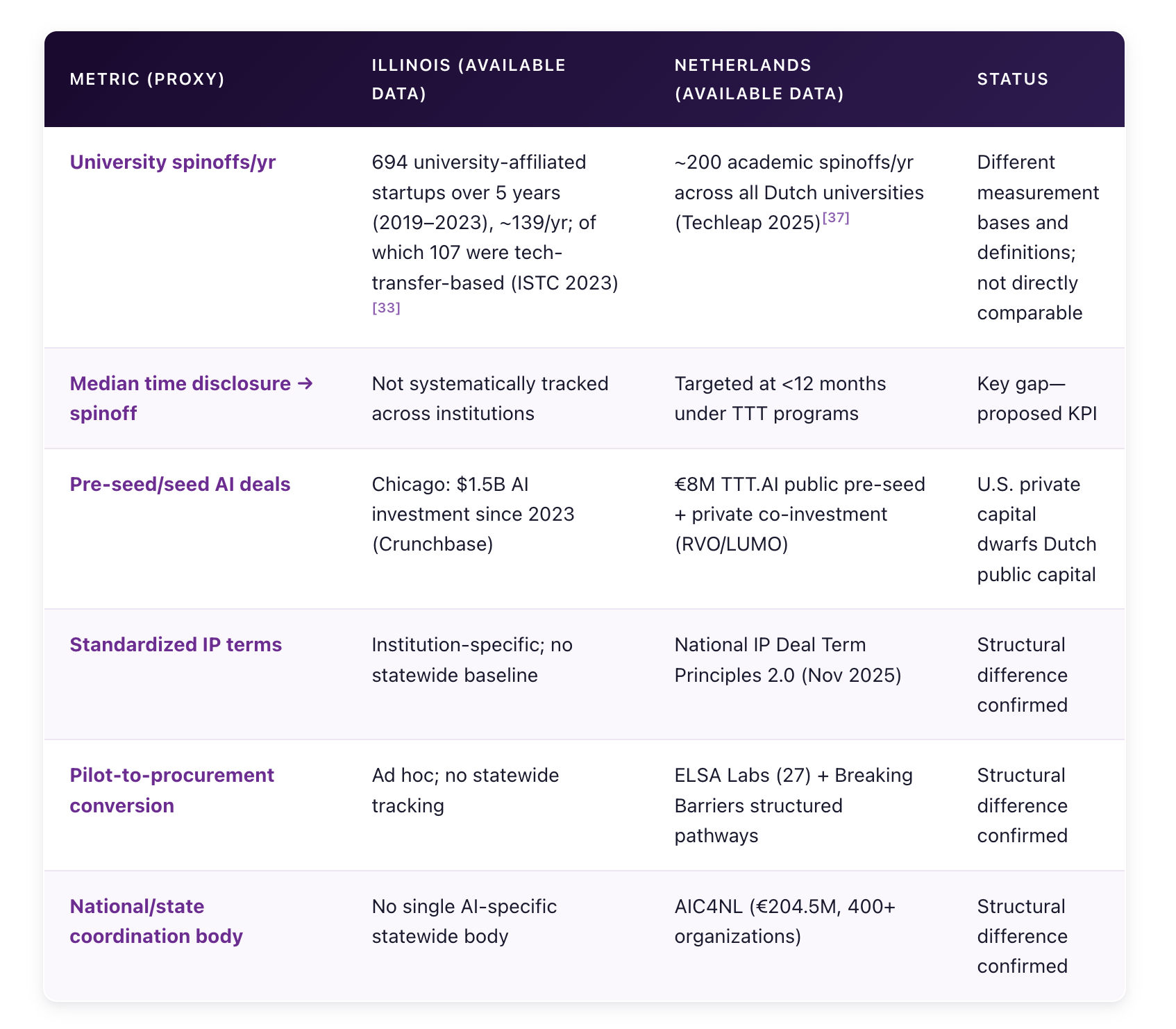
Interpretation Note
Several of these metrics are imperfect proxies with different measurement bases. The divergence claim rests primarily on architectural evidence—the presence or absence of standardized pathways—rather than audited outcome comparisons. Collecting comparable throughput data should be a first-order priority for any Illinois AI coalition.
What Illinois Can Do—Five State-Implementable Moves
(1) Establish an Illinois AI Coalition. Create a statewide coordinating body spanning agencies, universities, national laboratories, workforce partners, and private adopters, and publish a measurable AI Action Plan.
(2) Standardize spinoff/IP deal principles across institutions. Create baseline, market-aligned term principles and templates to reduce negotiation drag and improve investor confidence.
(3) Build a shared venture-building funnel with integrated pre-seed (“TTT-IL”). Treat commercialization as a pipeline with defined milestones, team formation support, and a warm handoff to seed and Series A partners.
(4) Institutionalize adoption pathways through paid pilots and procurement. Establish a pilot-to-procurement playbook so promising AI solutions can validate outcomes and scale responsibly.
(5) Commission an Illinois proposition-based investment blueprint. Identify concrete, investable deep-tech projects in Illinois advantage sectors—healthcare, logistics, manufacturing, agriculture/food, and finance.
Why This Matters Now
AI has moved from an innovation topic to an economic and governance reality. For Illinois, this creates a dual mandate: compete for the upside—productivity, new firm formation, better services—while building guardrails that sustain public trust. The risk is not that Illinois lacks talent or research. The risk is that, absent a more integrated commercialization and adoption architecture, Illinois may under-capture the economic returns on its research investments and industrial capacity, effectively subsidizing innovation that scales elsewhere.
Illinois’s existing investment trajectory underscores the urgency. The state has committed over $500 million to the Discovery Partners Institute and the Illinois Innovation Network, a system of 15 university-community-industry hubs projected to create 48,000 jobs and $19 billion in economic impact over ten years.[16][27] P33 Chicago has catalyzed over $160 million in follow-on funding for founders through its TechRise program and launched a $50 million hyper-regional venture fund.[28] Chicago attracted $1.5 billion in AI investment since 2023.[29] These are substantial assets—but they operate largely as parallel initiatives rather than as an integrated system.
The Netherlands’ recent policy and ecosystem activity offers a timely reference point precisely because it has tackled the “middle layer” between research and market—what many ecosystems experience as a valley of death. Consider how often promising academic AI remains stuck in a repeat pattern: a lab produces strong results; an invention disclosure is filed; a small team forms; founders spend months negotiating IP; early pilots happen through personal networks; and then the project stalls for lack of standardized pathways to adoption and follow-on capital.
The Netherlands has treated those seams as design problems. TTT.AI is a mechanism to make commercialization more repeatable across institutions. National IP deal principles reduce transaction costs. AIC4NL serves as an alignment engine that connects research, education, data, and applications with dedicated National Growth Fund support.
A Practical Framing
The core question is: How do we reduce time and uncertainty between discovery and deployment—while increasing accountability? That is a question legislators, universities, agencies, and private partners can answer together because each controls different parts of the pipeline.
Read the full white paper: